

Everyone makes mistakes. Everyone! The ones who claim they do not make mistakes are either not true to themselves or just aren’t aware yet of their mistakes. The true greatness of a highly professional engineering team is how the team as a whole deals with unexpected events and with mistakes made. The NASA team rose up to the event and proved their abilities to tackle any mishap, no matter how complex it is.
This is the 3rd post in the Hubble Space Telescope post series. If have not read the previous two posts in this series I strongly suggest you read the first and second posts before you continue with this post, since the content of this post is entirely related to the content of the previous two.
Problem Statement
To recap, we have a space-telescope with a large mirror that was defectively manufactured and as a result of which created a spherical aberration in the final image and thus making, at this point, the whole US$1.5B project more or less useless.
In optical terms we are “stuck” with the following performance:
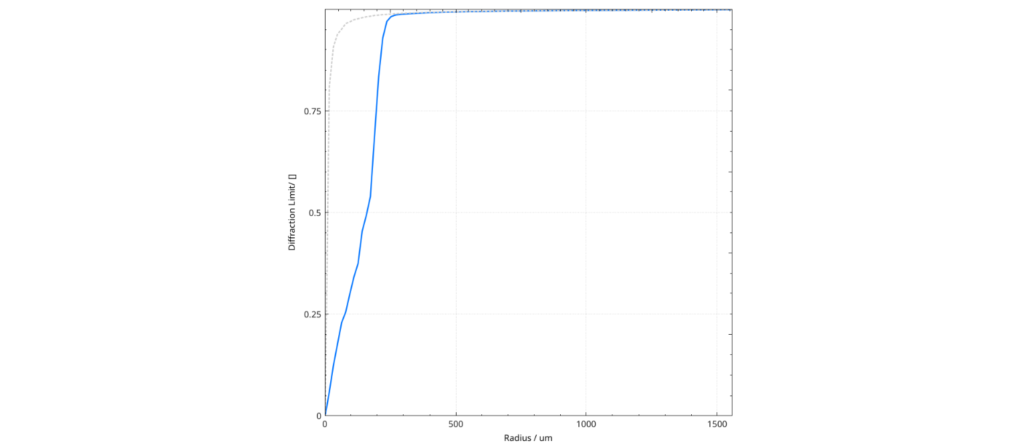
To make it even worse, the public conception of NASA’s abilities was at rock bottom as you may learn from the following scene from Armageddon (“for 30 years they question the need for NASA”), so we can only imagine the pressure the Hubble engineering team felt at the time.
The Optical Challenge and The Solution – Corrective Mirrors
First and foremost, the team must find some kind of a fix for the immediate problem. Is the problem a spherical aberration? We go back to basic optics – when mirrors are involved, addition of an aspheric surface corrective mirror will do the trick when calculating the opposite asphere that will compensate the spherical aberration that was created by the defective main mirror. The proposal to introduce this correction method was made by Dr. Murk Bottema – introduce pairs of spherical + aspheric mirrors per optical channel.
Let’s look at the theory of this solution in the visible light range as per our example:
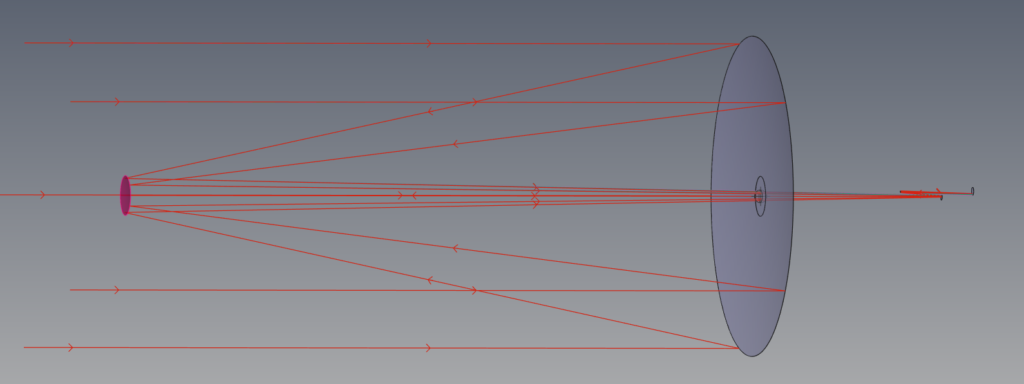
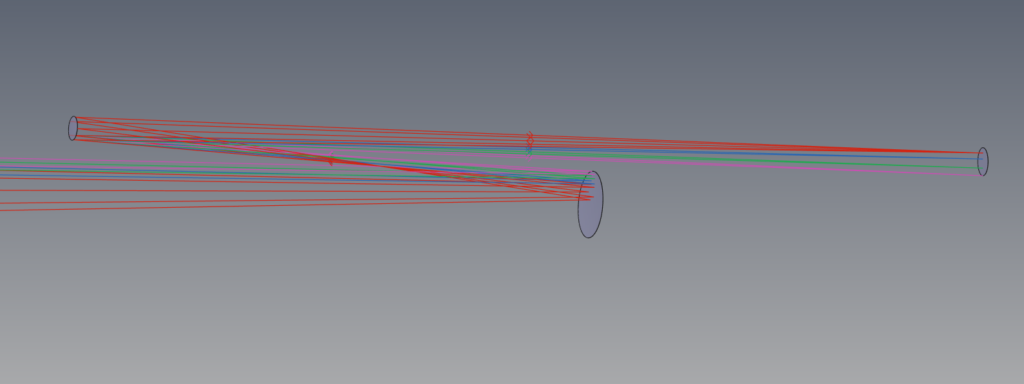
On the left we see the full optical design with the main and secondary mirrors and on the right we can see a zoom in of the additional two mirrors that were inserted into the optical path to correct the spherical aberration caused by the main mirror.
When introducing these two mirrors the faulty enclosed energy graph turns into this:
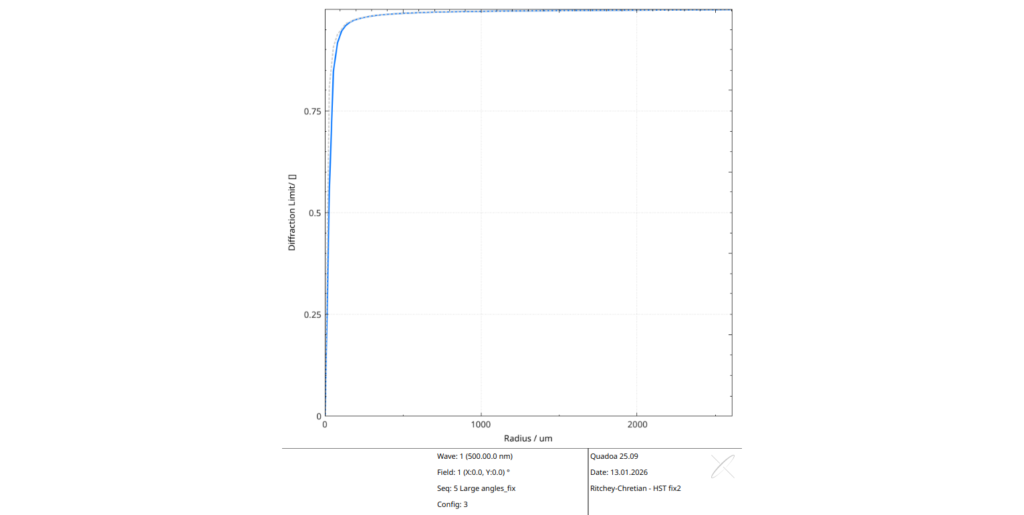
Back to diffraction limited design!
That’s when the COSTAR (Corrective Optics Space Telescope Axial Replacement) was born.
There is a gap between an optical sketch and reality. Optical sketches give us the essence of how, in the ideal case, the rays should run– when the optical components “float” in thin air. However, right after we have the ideal case we are required to apply the mechanics, tolerances, moving parts, environmental variables and so on, only to figure out if indeed this optical concept holds. The reality of mechanics might bury the most beautiful optical concepts merely because demanding requirements of the pure optics.
A quick side-note: it was not mentioned before however that the Hubble Space Telescope was sent into space with 4 different optical sensors: Faint Object Camera (FOC) in the UV-Visible range, Faint Object Spectrograph (FOS) in the UV-NIR range, Goddard High Resolution Spectrograph (GHRS) in the UV and a High-Speed Photometer (HSP) in the US-NIR range, each with different optical configurations. Each optical channel configuration required a different correction hence different mirror combination.
Accordingly, Dr. Bottema’s optical concept was there: pairs of spherical mirrors and aspherical mirrors were to be introduced into the optical axis between the secondary mirror and the relevant imaging sensor.
These mirrors had to somehow fit inside an in-orbit satellite telescope so two obvious challenges had to be considered: the physical space for the corrective optics and a service method to install the solution in space.
The Epiphany
The solution came from a very interesting series of events. James “Jim” Crocker, a senior systems engineer (what else  ) at NASA, was taking a shower in his hotel when he noticed the European-style shower-head mounted on adjustable rods. The maid had left it folded flat against the wall. When he extended it, he realized he had the solution in front of him, as he himself was quoted as saying: “I could see Murk Bottema’s mirrors on the shower head.”.
This true story comes to show us that Muse can pay us a visit for an historical inspiration anytime and anywhere.
The solution was “simple”: for the use of each optical channel two arms, each with the relevant mirror, that go into the right place inside the optical path to compensate for the aberration. The mirrors then go in and out of the optical path with different arms. This solution obviously required space inside the hull of the satellite. To clear that space the High-Speed Photometer (HSP) optical channel was removed. This solution was by no means a “micro-optics” solution: the whole assembly was the size of a “phone-booth” (do you even remember what a phone-booth is??? ).

The Service Mission
On December 2nd, 1993 mission STS-61 was set on board the Endeavour Space Shuttle to repair the Hubble Space Telescope. The repair mission included 7 astronauts of which 5 were defined as “mission specialists” – all had special training and lots of rehearsals on earth in preparation of the mission. No-one really counted the number of support team members on the ground but it is estimated in thousands of NASA people.
The whole mission took nearly 11 days, out of which about 35 hours of repair work out of the space shuttle (spacewalks).
In early January 1994 the first corrected images came through to everyone’s satisfaction.
System Engineering Lessons
There are a few important system engineering lessons from this interesting solution. I would like to give my view of the solution events.
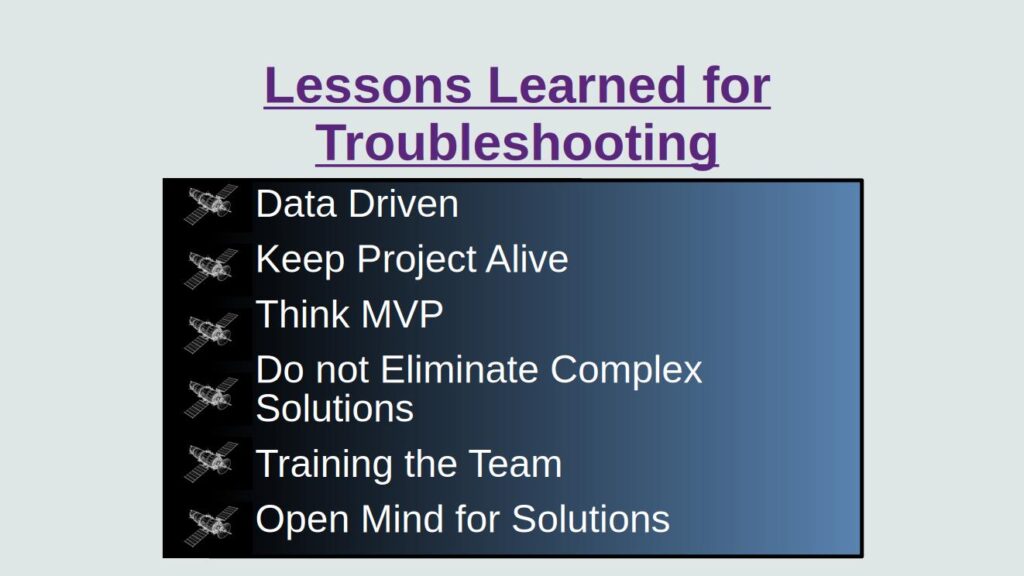
- Data driven solutions: the NASA team put in a huge effort to get the very bottom of things in analyzing exactly what went wrong. When having the exact numbers of the spherical aberration induced by the main mirror the path to an optically precise solution was, one way or another, only to connect the dots. There were of course other optical solutions, some of which were implemented in later service missions. Analytical review of the problem is, anytime, the source for the optimal solution.
- Keep projects alive and do not bury projects needlessly: a malfunction in our product, large or small that it may be, is not enough of a reason to shutdown the project and start searching for another job. We face the challenge as long as the product may serve its role to spec. There is an important caveat here which cannot be learned from the HST failure – there are times where we should know when to shutdown and start-over the project or the product. This is not one of these cases.
- Think MVP: Project success may depend on the ability to eliminate features that are outside of the MVP (Minimum Viable Product): the simple understanding that the Hubble Telescope’s performance would suffice without the High-Speed Photometer to (almost) everyone’s satisfaction was a major step in realization of the whole solution. Think of how many products’ specs or timeline were sacrificed because of features that were outside of the MVP in your projects.
- High complex solutions may be the difference between a successful project to a failed one: do not be afraid of complexity. We live in a very diverse world with a lot of interactions between components with more and more complex systems-of-systems. In many cases the straight-forward and simple solution does not exist. Continue your research until a solution is reached and the specifications are met.
- Train the crew in-house: how many times have we sent a technician to the field to fix a malfunction only to discover that constant remote support is needed or even worse – we send the technician back to the office to do homework only to return to the client at a later stage. Train the crew before you sending them to the repair work. When doing in-field repairs or upgrades leave minimum for creativity and improvisation.
- * Keep an open mind for Muse at all times: you never know where the initiative or inspiration for a solution may come from or when. Keep an open mind for solutions to your day-to-day problems. I can testify that one solution to a major problem at work came to me from my son when he was 5 years old. I got him a very big portion of ice-cream that weekend .
Further reading: This report was written in November 1990, 7 months after the Hubble Space Telescope went into orbit. It is a comprehensive (and long!) report with all the details required to fully understand the failure event end-to-end. From there you may continue to this servicing mission chapter and work your way from there to other sources. Wikipedia’s entry for the HST is also a good source of information.
To sum up, the Hubble Space Telescope proved to be a very successful project over the years which gave way to many scientific advancements which would not have occurred otherwise. The Hubble Space Telescope is still active today and expected to remain active until 2030, 40 years after its initial launch. Over the years it had 4 more service missions (5 in total), the last of which was in 2009 which was declared as the final update and upgrade mission to for the telescope. Moreover, NASA’s reputation was, at least in the late ‘90s and early 2000s, restored in full.
We should also take into consideration that as early as 1996 NASA teams had already formally started working on the Hubble’s successor – the James Webb Space Telescope made it perfectly clear that the HST was indeed a great success.
And for our entertainment, you may take a look at the image gallery in NASA’s website to witness the beauty of outer space as seen from this amazing telescope.
The telescope’s first steps in orbit are a very good System Engineering lesson for any project if only to demonstrate how even a flow of events that lead to an extreme manufacturing malfunction could be solved in the most demanding conditions.
And remember, “anyone who has never made a mistake has never tried anything new”. Do not be afraid of making mistakes, just make sure to recover correctly and smoothly to resolve them and make sure to learn from your past mistakes.