
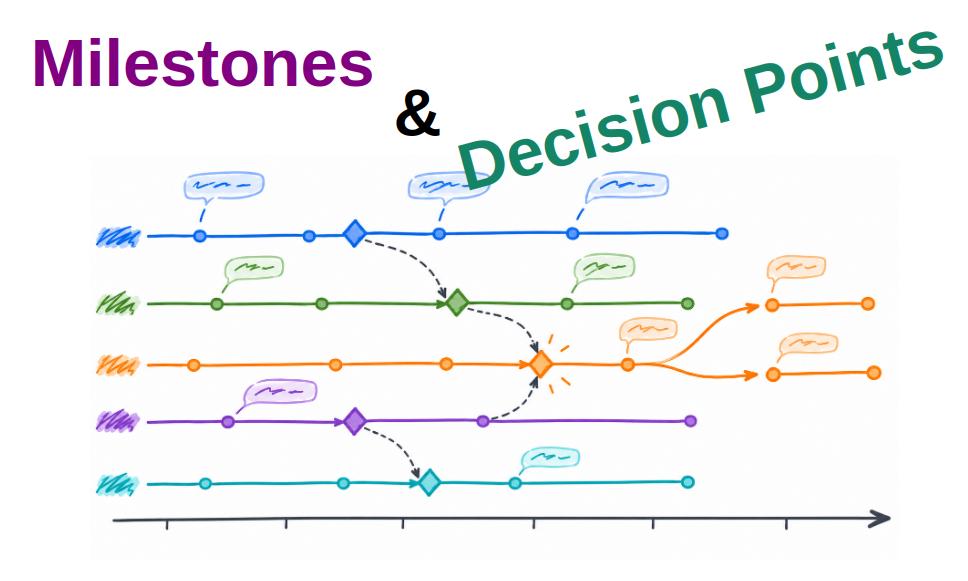
Usually, our main professional joint goal when we come to work is to accomplish a certain task or a project successfully. When coming to judge whether a project was a success or not successful from an altitude of 30,000 feet, we usually measure the business merits of calendar time, resources and money that were exhausted during the project. One level lower to better assess how the project was executed is by examining the milestones and decision points during the project. In this post we will dwell on these two project markers.
This post is more of how System Engineering integrates inside project management or in the development process than an actual engineering contents however, as we keep pointing out throughout this blog, because the System Engineer serves as a technical authority of the project the burden of project-success-responsibility falls on his\her shoulders as well.
Definitions
Milestone and Decision Points are two project-management tools to allow better tracking and control over the project progress.
Let’s begin with a few definitions to make sure we are all on the same page.
Milestone
A milestone is an important goal, achievement or a checkpoint in a project. For example: critical reviews, first assembly, first beta on-site etc. Milestones should have a due date attached to them. Floating date for a milestone can also be used, however it is less of powerful project-management tool without a set date and makes timeline-management very difficult.
Decision Point
A decision point in a project is an event where a critical path has to be determined for the project. For instance: technology path decision, vendor selection, product content etc.
A decision point can be milestone driven or time driven.
Dividing the Project into Milestones
The decision process of what a milestone is in the project is crucial. It impacts everything from resource allocation through sub-contractors payment schedule and up to product delivery and even company events and happenings; (imagine how frustrating it would be to be pinned to your laptop during a company retreat just because the HR department was not updated that a crucial milestone was postponed and as a result the whole team had to work during the vacation).
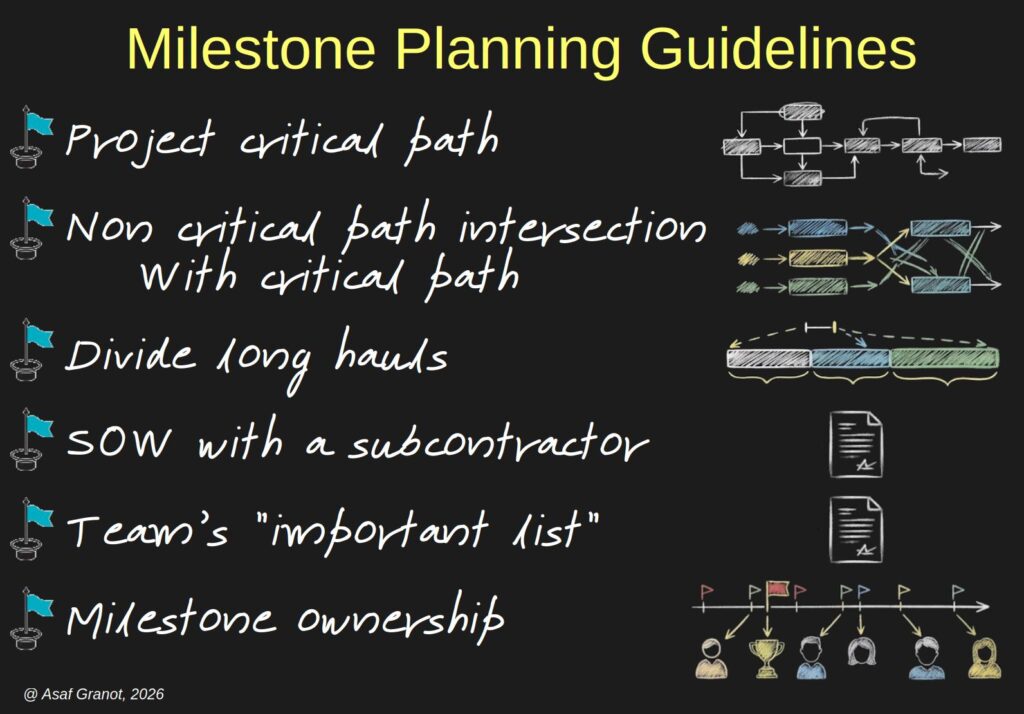
Here are a few guidelines of how to approach milestone planning
- Draw the critical path of the project: starting point, ending point and every task or achievement big enough on that path that you can think of. Examples in a R&D project for such tasks would be: PDR, CDR, purchase order of parts, SW ready, delivery and so on. Usually, the first things that come into mind are to-be milestones for that project.
- Draw the non-critical paths of the projects and check when and where they intersect with the critical path. For example, a nice-to-have feature development that when ready is integrated into the product. The intersection of these paths with the critical path may serve as a milestone.
- Divide long hauls in the project into shorter deliveries (to allow better tracking). For example a 1000 patients clinical trial that was initially written with only two milestones – “start” and “end” could be divided into 5: start trial, first 50 patients, 250 patients, 600 patients and end.
- When issuing a Statement of Work (SOW) with a subcontractor a project-dependent-payment to the subcontractor shall be divided into milestones for the subcontractor and must be aligned with deliverables of the project (milestones or not, in the subcontractor’s book these are milestones).
- If the team thinks it’s important, it is a milestone!
- Each milestone must have an owner.
Be careful of too many milestones during a limited period of time. Milestones are reserved to the most important steps of the project. On the one hand we would like the milestones we choose to pave a path from start to finish of the project to track and follow, on the other hand milestones cannot serve as 2-week sprint-targets. Think of a milestone exactly as the Miliarium was in ancient Rome: a marker on the road once in a while so you’d know in top level that you are on the right track.
Milestones and Schedule
Very often one hears questions like “what if such and such milestone completion is postponed?” or “could we skip this milestone?”.
First, usually the simple answer to the first question is that the project will be late and for the second question, well, no!
Second, we plan the milestones for a reason – to keep the project inside the timeline and flow we have set in advance. Yes, changes may happen (see below in the section about decision points) but eventually, when a milestone completion is postponed, it usually means that the whole project is postponed.
The reasons for late completion can vary of course, depending on the milestone’s activity and content.
One more thing: in large companies, milestone in-time completion is one of the only effective tools for the top management to assess if the project is progressing in a timely manner.
Planning Decision Points in a Project
Correct planning of milestones must include decision points. A decision point is a fork on the project’s path where we must choose which way to go – left or right (or even backwards). Decision points can be timeline driven i.e. the decision has to be made by a certain date, or they can be activity driven i.e. when such and such activity.
Design Reviews are the obvious example for decision points – these reviews are go\no-go decision points whether to continue forward with the project as planned or not. However, design reviews enter the milestone list on their own right and the reference to a “decision point” is something more profound in this post’s context.
Better examples for less obvious decision points are: choosing a technology out of N available technologies, choosing a vendor out of the list of available vendors, assess a clinical trial to decide if a change of protocol is required, deciding whether a technology is mature enough to integrate in a product etc. In all of these examples there are multiple choices to go forward but at one point or another we must choose which way the project is going.
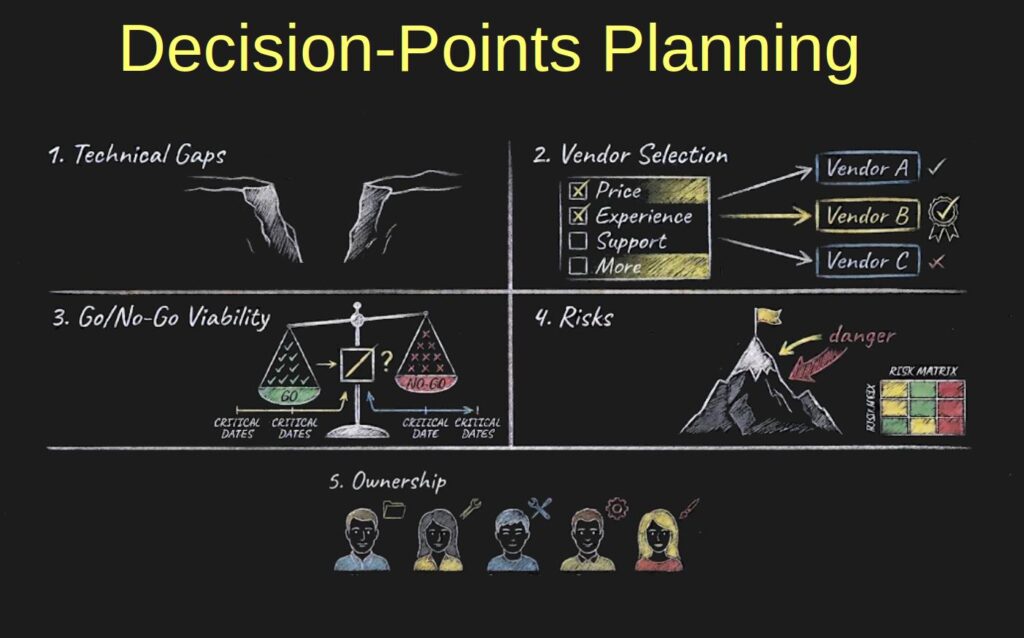
Here are a few guidelines for planning decision points in an R&D project:
- Map the technical gaps of the project. Open technical questions with different solution paths will always get an activity-completion-driven decision point.
- Vendor selection will get a decision point. It can be date-based counting backwards from the last date to place a purchase order or activity-completion-driven based on testing and experimenting the different vendor’s products.
- Go\no-go for a project viability decision points should always be bound with a date and this even if in their essence they are activity-driven. If the activity is completed before the due date, the decision will be made earlier.
- When going over the project’s risks, each high risk must get a decision point to deploy the mitigation in-time to keep the project on-time.
- Each decision point must have an owner and a person who has the casting vote.
Decision Points and Milestones Correlation
It is very easy to see that there is a connecting line between decision points and milestones.
In many cases the decision points’ input is data and activities that are a part of milestones and after a decision point milestones can be totally altered.
As a result, the immediate conclusion is that postponing decisions would eventually temper with milestone on-time completion. In many cases the decisions are scheduled to a later-than-planned dates only because of the gravity of their outcome. The best example I can give is a start-from-scratch of a project that already has a long and painful bill because, well, it just does not work. The data is there, now we have to be brave and take the decision.
In addition, when a decision is postponed both the resources required for the decision making and those required for the consequence activities are being held. Remember, not taking a decision is as bad or even worse than taking the wrong decision.
Obviously, I am not referring to the case where the data is missing or the activities required were not completed yet. If these are delayed for any reason, well, that’s life and let’s plan our resources and time better next time.
A word of caution: meetings held to conduct critical decision points can sometimes be hijacked by people (or AI agents  ) who do not have enough knowledge nor the authority to make the decision at hand or even to postpone or reschedule it. In corporate companies it may happen more than you think. Always have the team informed who is the owner of the decision and who is to make the final decision. That may save a lot of confusion and unnecessary delays and frustrations.
Commitment to Milestones
Not without reason does the title of this post mention commitment to milestones.
Assuming that the successful completion of all milestones on time indicates a successful project, how do we make sure that we stick to the milestone plan?
Unfortunately, there are no guarantees here, only best practices.
First, plan the milestones carefully and keep your feet on the ground – do not set impossible goals or impose a 24/7 schedule on the team. Once planned, take these milestones seriously.
Second, each major risk or gap must have its own decision point.
Third, take ownership of decision points. Make decisions whenever you can – indecision is very often a cause of delivery delays.
Fourth, as we keep repeating in this blog, no one knows everything. Allow enough room for unknowns and have spares when planning the milestones and all the checkpoints. It is rare for these allowances not to be fully used.
Fifth, remember that no plan is sacred. If the plan does not work and milestone after milestone is either not completed on time or not accomplished at all, be professional and change the plan. It is also important to admit when things are not working and when it is time to turn around.
And lastly, when the milestones make sense and the rationale and line of thought have been properly communicated to the team, can trust the team will be fully committed to the milestone plan. A good plan is the key to achieving such commitment.
Project Assessment
Let’s go back to where we started this post.
Imagine an R&D manager trying to figure out what is the status of the 25+ projects the teams are working on. A dashboard with only the projects’ milestones and decision points laid out on a single screen in front of him\her will give that manager an immediate answer – which project is late, which project requires immediate resource-boost and when is the next meeting for a critical path decision.
Furthermore, such a tool can serve as an assessment tool retrospectively – take 3 projects that were recently completed and delivered to the clients and now let’s have a quick look what milestones were accomplished in-time, which project decisions were easy or difficult to make and accordingly plan the next project timeline and resource allocation.
That’s it for now. In this post we examined two important tools for project management and tracking. When used correctly the milestones and decision points have only advantages in project management.And above all, the most important thing is the happy hour when a milestone is completed successfully…